Visions
A poem about the aging of bodies and places

Well, we are one month into a new year, and January has felt 100 months long. I was going to write something flippant like: Do we still feel the possibilities and potentials? But I can’t. There is too much heaviness, too much suffering. I frankly don’t know how we are getting from one day to another.
If you know me or have been following my writing during the past year, you know that a lot of my life right now is occupied with aging parents and eldercare. It seems to be something that people don’t talk about as much as parenting young children. The experiences, however, are remarkably similar. They are both physically, mentally, and emotionally exhausting. There is also the shared moment when one’s patience has been tried to the max, only to receive a spiritual reset when watching their innocent sleeping.
Yet, childcare and eldercare differ in the most profound way—one carries the sense of new life and abundant potential, while the other offers only decline and death.

My poem “Visions” was published this month in Vol. 22 of Corporeal Literary Magazine. Their mission resonates deeply with me.
“The mandate of Corporeal is to host work that explores, explains, and/or troubles our experiences of embodiment; that is, the having of a body. How being embodied, being held and perceived in your body, colours the way you live and are received in the world.”
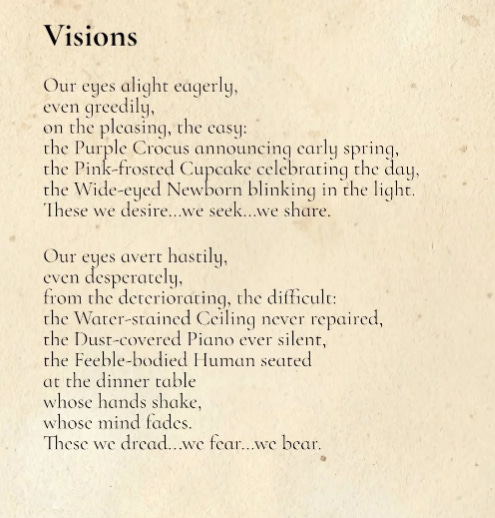
This poem began, as most do, with words and images scribbled on a scrap of paper. My husband and I were visiting his parents in South Carolina during the summer of 2023. My father-in-law, who had dementia, sat at the dinner table next to me. We didn’t know it would be for the final time. I will admit that I felt uncomfortable seeing his physical deterioration and how the house itself and the objects within seemed to mirror this decline. The act of averting my eyes caused me to think about what we are willing to witness fully. This is the poem that came from that.
Decline is so difficult to watch.. Thank you for sharing.
Such a beautiful poem, Kellie. Its simplicity and directness, and those two rhythmic, rhyming lines at the end of each stanza.
From Rebecca Solnit's The Faraway Nearby: "They say that Alzheimer's mimics childhood run in reverse, but children's voracious minds are seizing on the knowledge that's disintegrating at the other end of life, and the conditions are as dissimilar as gaining and losing."